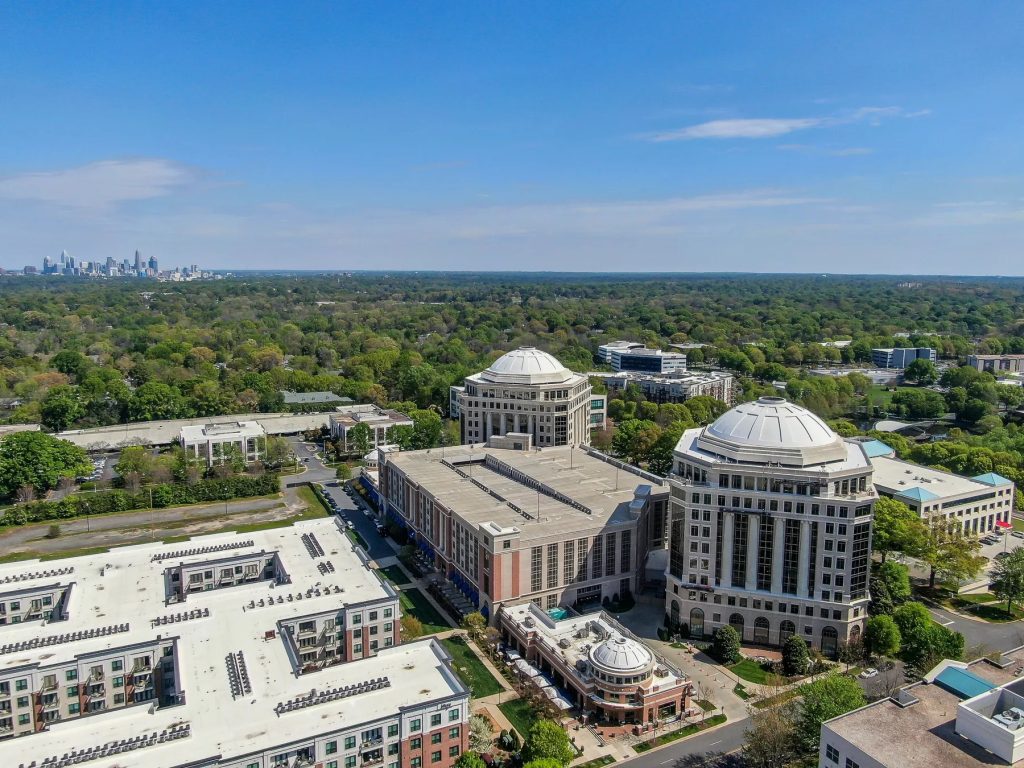
Indian Land sits in an unusual position for a residential market of its size. It is not a town. It has no mayor, no municipal code enforcement, and no town police department. Lancaster County governs land use through its Unified Development Ordinance, and the Lancaster County Sheriff’s Office handles law enforcement from a substation on Sandal Brook Road. Water and sewer run through the Lancaster County Water and Sewer District, which built a dedicated treatment facility here in 2001. Residents voted against incorporation in 2018 by a margin of nearly five to one. Understanding that structure matters before you make an offer, because it determines who you call when something goes wrong and what approvals govern what gets built next door.
The housing stock reflects the community’s timeline. Almost all of it postdates 2000, and a meaningful portion was built after 2010. That uniformity shapes the competitive landscape in ways that are specific to this market and do not apply in the same way to older Charlotte neighborhoods like Myers Park or Dilworth, where age and architectural character create differentiation that builders simply cannot replicate. In Indian Land, nearly every home is recent construction, which means condition and finishes are table stakes rather than advantages.
What Buyers Face in Indian Land
The first practical challenge is the 29707 ZIP code itself. Federal school data for that ZIP radius returns results from both Lancaster County and York County’s Fort Mill school district. Lancaster County School District does not publish an online attendance zone lookup, which means confirming which school serves a specific address requires a direct call to the district. That is not a minor detail on a purchase in this price range. The county also applies a school impact fee to the Indian Land service area specifically, which is a cost item worth understanding on any new construction transaction.
The second challenge is that buyers here are not choosing between resale homes. They are choosing between a resale home and a model home a mile or two down US 521, where a builder can offer incentives including rate buydowns that a private seller cannot match. That competitive dynamic is structural, not seasonal. It exists regardless of when you are searching, and it requires buyers to be precise about what they are actually comparing. A builder’s base price rarely reflects the finished cost of a comparable resale home once lot premiums, upgrades, and the actual closing timeline are factored in.
Attached housing, primarily townhomes, is a meaningful share of the inventory along US 521. If a townhome project is recorded under South Carolina’s Horizontal Property Act, lenders treat it as a condominium. That affects financing options, down payment requirements, and the buyer pool when you eventually sell. Confirm the legal classification of any attached property before you proceed, not after.
In Indian Land, a resale seller’s real advantage over a builder is everything a contract cannot transfer: a finished yard, mature landscaping, a screened porch, window treatments, and a closing date that does not move.
What Sellers Need to Understand
The buyer pool arriving in Indian Land is largely relocating from North Carolina, and they arrive with a specific calculation already running. South Carolina property tax treatment, Lancaster County schools, and a drive to Charlotte that is shorter than it appears on a map because the state line is roughly five miles away. These buyers are analytical and comparison-oriented. They are not making an emotional decision about a neighborhood they grew up near. They are running arithmetic, and part of that arithmetic includes what a builder is offering two miles down the road.
With almost no pre-2000 stock in the market, there is no age premium available to resale sellers. You cannot price on character or history. What you can do is price and present around the things a builder genuinely cannot deliver: a yard that is already established, a fence that is already up, a screened porch that is already built, and a transaction that closes when it is supposed to. Those are real advantages, but they only work if they are stated explicitly in the listing. Assuming a buyer will notice is a strategy that underperforms in a market this analytical.
Sellers of townhomes face a more specific financing consideration. If your property is classified as a condominium under the Horizontal Property Act, the buyer’s lender will treat it accordingly. That can affect who qualifies to purchase, what down payment is required, and how long the financing process takes. Pricing and timeline expectations should reflect that narrower buyer pool rather than assume the same dynamics as detached single-family product. For sellers thinking through a move-up from Indian Land into a larger detached home, the sequencing of that transition deserves careful planning. The decision to sell first or buy first carries different weight in a market where builder competition is a constant variable.
If you are thinking through what Indian Land looks like for your specific situation, whether as a buyer running the comparison against new construction or a seller preparing to compete with it, Tim Petrinec works with clients who take these decisions seriously and want analysis before they act. Reach out to schedule a conversation about what the current market means for your position specifically.
The Indian Land neighborhood page covers this in more detail, including an overview of what makes this market distinct from other communities along the South Carolina side of the Charlotte region.